
Apps and Agents
The AI Agent Cares About Your Building, Not About Your App
Sometimes being late to the party is a blessing. Especially if you arrive fresh, when the action is about to kick off but some of those present are already tired. An analogy in the tech context is many developing nations skipping landlines and moving directly to mobile, or Estonia building a digital government after Soviet rule instead of paper-based bureaucracy.
In mobility the tired solution is the app, and the new kid in town is an AI agent. While apps offered a terrific business model – a walled garden with zero marginal cost – and in many cases a good customer experience, they left plenty of room for improvement. An app is a one-size-fits-all solution, many still require a whole lot of punching, and when service providers guard their customers the number of apps needed grows. And so does the consumer’s frustration.
Enter AI, the all-powerful, intelligent mother-portal to everything. Not only can you satisfy all your needs through one interface, but the agent knows you, your needs, your contexts and your history and can recommend and execute choices that are constructed just for you and just for the situation you’re in.
What a Day of Testing Taught Us
Up until now MaaS (Mobility as a Service) has meant an app. All modes of transport available collected on a screen and organized as travel chains according to the customer’s needs. Today, as we are building the next generation of MaaS, we are realizing that the apps were a product of an era that is quickly passing.
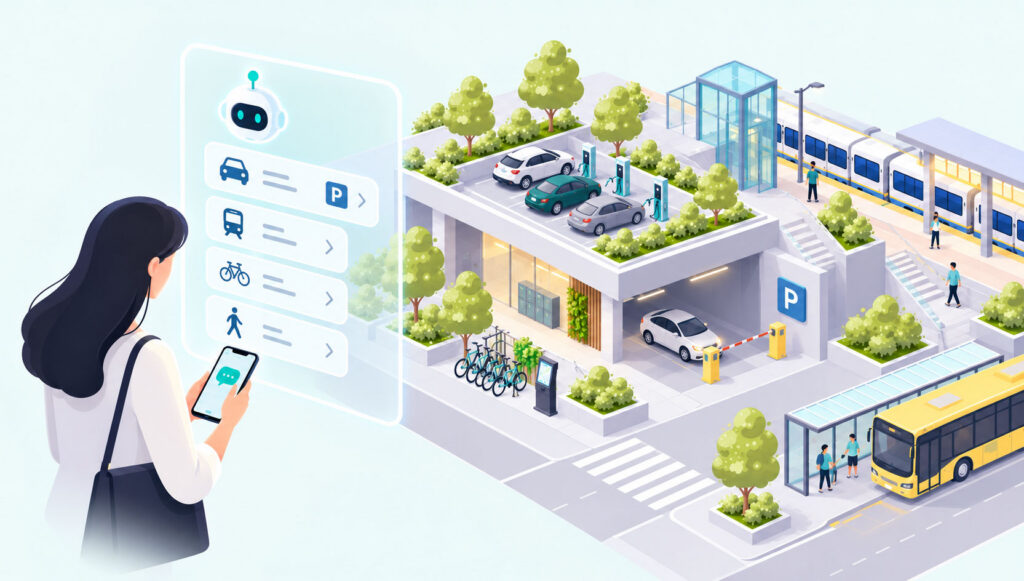
The other day we did an exercise here at Swavia. We prompted Claude to act as a parking agent, choose the closest and most accessible parking garage for the situation, with charging, with car wash and with connections to other modes of mobility. We added the payment options and checked that the interfaces with service providers worked. All of this took us a day – and we were looking at a next-level customer experience. Our conclusion, slightly stunned but very clear: no, we should not focus on our own app and give it AI capabilities. We should focus on how AI agents use what we have on offer.
We are of course not alone with our small test of a megatrend. In mobility many are already talking about and getting ready for travel concierge agents. Several service providers are increasingly skipping the app. In the US, drivers can already reserve and pay for parking at more than 30,000 locations without leaving Google Maps or Waze (thanks to the operator platform Flash) and Perplexity finds restaurant tables in conversation (before handing the booking to OpenTable). A new ecosystem is being built.
The Garage as a Strategic Asset
What has been observed less is how this will change the real estate business. The main question for real estate owners and parking operators may not be, “how do we keep our garage on the AI radar” but rather “is our garage strategically positioned for the agent economy”. Here are a few thoughts on this new economy and how it affects real estate:
- Real estate stands to profit from late arrival. It does not have the burden of proprietary consumer apps and can go straight to being agent ready. Agents don’t care about brands, they care about legibility: availability you can query in real time, prices a machine can read, and charging status. Agents choose on data and that levels the playing field for anyone wanting to excel in the new economy.
- A parking garage can become a strategic asset. If the AI sees it as a well-positioned, well-connected and well-equipped hub, it will recommend it to the user. A building with a hub like this is far more lucrative than a poorly connected and badly positioned one. The one who controls the best garages controls the highest earning real estate.
- The value of the parking garage is also increasing because an AI does not own the parking spaces nor does it control the fleets. It can connect, but it cannot promise. While customers have more say than ever through their agents, those who control the desired physical assets have pricing power.
- Apps were one-size-fits-all solutions that presented their provider's catalogue. An agent serves its user's brief. When apps often solved a single need – paying for parking or getting a bus ticket – agents solve whole trips. Hubs that provide, not just parking, but services and connections, are winners in this setting. The power shift from app providers to AI users is clear.
- This means that the middle layer – apps and booking intermediaries – gets squeezed. A property owner should review its contracts: who sets the price, who owns the booking data, who has a say about the APIs? If you have a prime garage, be careful to reap the benefits yourself and not give them away through ill-considered partnerships.
- While customers are sometimes slow to migrate to new technology, relying on consumer inertia is a poor strategy. A Bloomberg article in September described how major banks, insurers and online travel agencies are also seeing their stock prices hit because their business models partly rely on customers sticking to their habits. AIs compare every time and smart investors know this.
Slow Assets, Fast Agents
The world of physical assets always moves slower than the digital world. The good news is that this gives you some time to adapt, test and improve. But there is no time to waste. Agents learn fast which assets work reliably, and that knowledge compounds. Being legible early is the advantage.