
When the Two Giants Collide
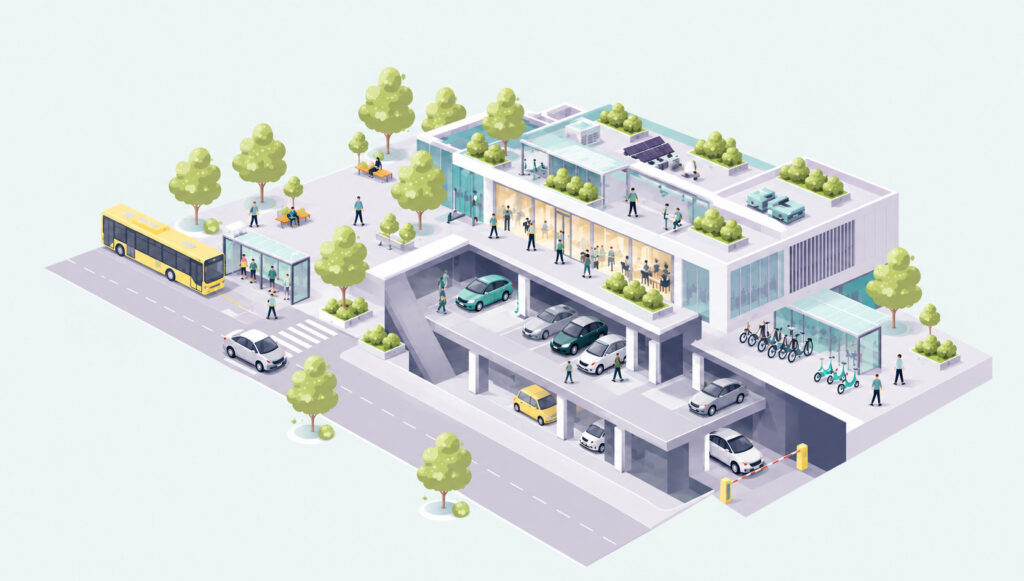
The Newest Chapter of the Oldest Idea in Real Estate
Quite a few buildings sit on top of an asset that almost nobody prices correctly: the garage. Real estate and mobility, two giants of the modern economy, have always weighed heavily on each other's worth – this is old news to anyone in either business – but the mechanism connecting them is changing, and the buildings that adapt first stand to be worth measurably more than the ones that don't.
The Oldest Idea in Real Estate
The formal study of this interdependency originated on a farm in Mecklenburg, Germany, in 1809. Back then Johann Heinrich von Thünen – a landowner and farmer who developed his economic theories independently of the academic mainstream– bought the manor of Tellow and began keeping meticulous accounts of his own estate. From that data, in 1826, he published a book titled Der isolierte Staat ('The Isolated State'), making the claim that the value of land is not intrinsic to the land – it is a function of how expensive it is to connect that land to everything else (not his exact words, but this idea earned him recognition as the founder of spatial economics).
In agrarian societies, that meant the cost of getting produce to market almost dictated the cost of land. In contemporary society, the proximity to work, fun, schools, and services largely determines the price of residential real estate; for offices, it is the proximity to customers, colleagues, airports, and parking. Another way of saying location, location, location is connection, connection, connection.
Beyond Parking
In PropTech, connection has been a buzzword for a while but mostly framed around parking. Smooth parking arrangements mean smooth connections, and that experience can be enhanced with user-friendly applications. Easy parking becomes a feature of real estate. But a parking space, no matter how integrated into a residential or commercial space, isn't exactly new either, even with the new interfaces.
The market bears this out. Europe's largest parking operator, APCOA, manages over 1.8 million spaces across 11 countries, and a wave of fast-growing challengers – several with triple-digit annual growth rates – are digitising parking at pace. But nearly all of them, incumbents and challengers alike, are still optimising parking as a single service rather than treating the garage as a multimodal hub. That gap is the next chapter.
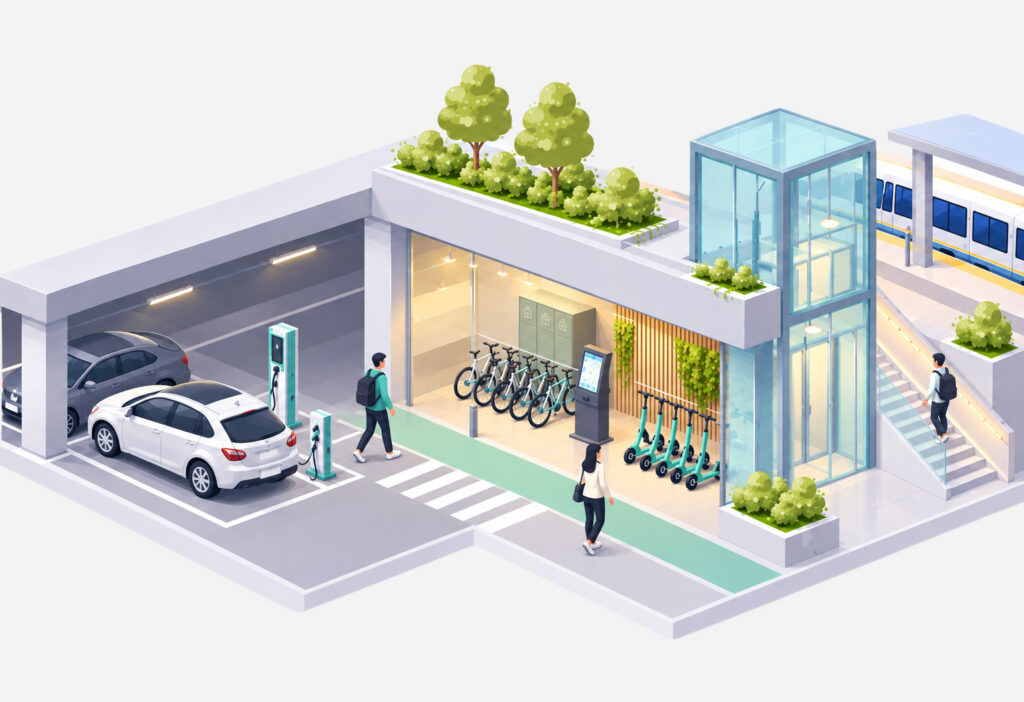
The Garage as a Hub
The next chapter in mobility's interaction with real estate means that multimodal connectivity is embedded into the building. Or, in other words, multimodal mobility becomes a feature of a building. The garage becomes a hub where a car owner can leave their car and continue their journey by some other means. A person without a car finds a buffet of options – rental cars, taxis, bikes, scooters, whatever they need – to conveniently reach their destination, which may itself be another mobility hub connecting to the metro or train system, to airports, to ferries…
This is not hypothetical. Clouth 104, a mixed-use quarter in Cologne built on a former rubber-factory site, has already converted its central garage into exactly this kind of barrierless mobility hub – car-sharing, EV charging and bike storage behind one access system – and the project became one of the first in Germany to receive a Good Mobility Council pre-certification for its approach.
While traditional traffic planning has been lane-based (how do I get to the lane that takes me to where I am going), the future will be hub-based. Hubs connect to each other in multiple ways, and buildings become part of this web. The better the hub in the building, the more desirable the building is. This desirability, of course, translates to increased prices or rents.
Mixed-Use and Offices Will Adapt First
Any building with parking can become a hub: a shopping centre, an office complex, a residential building – but it is most likely that the evolution will start with offices and mixed-use buildings, where a single tenant or landlord has both the incentive and the authority to act. The scale of the opportunity is considerable: the DACH region counts roughly 8.5 million regulated parking spaces (European Parking Association, 2024), and in Germany's larger cities alone, operating parking already generates upwards of €5 billion a year – most of it still running as a simple, static asset.
A company has a strong incentive to optimise its fleet and the parking spaces it pays for. A garage that is no longer just a garage offers an opportunity to do just that. Instead of a car and a space, an employer can offer access to a hub. While there is a strong economic argument to do this, there is also a strong environmental and cultural one – Germany alone has set a target of one million public EV charging points by 2030, and a garage that already has the wiring, the software, and the parking permits in place is far better positioned to absorb that shift than one that does not. This is the future. Mixed-use buildings are, of course, natural hubs because of their many layers of users, activity, and mobility needs.
The Value Is in Connections
To a real estate investor, parking is a must-have but rarely a profit centre. An efficiently run hub can be more profitable than a garage – but more importantly, it increases the value of the complex if it offers a superb set of connections. The economics bear this out: in a mature multimodal hub, parking itself typically accounts for less than a third of total hub revenue, with mobility services, community offerings and charging making up the rest – meaning a well-run hub can roughly double a site's revenue potential compared with running it as a parking garage alone.
That is the shift underway: not a new feature bolted onto parking, but a genuine repricing of what connection is worth. In future pieces in this series, we will look at how the asset managers already ahead of this curve are running these numbers on their own portfolios – and what separates a hub that merely works from one that pays for itself twice over.